INDUSTRIAL ENGINEERING
Typically the role of the Industrial Engineer is to constantly strive to make things work better, whether it involves processes, products, or systems. The Industrial Engineer is the bridge between management goals and the company’s operational performance.
Typically the Industrial Engineer’s activities focus within the following:
- Project and program management
- Manufacturing and distribution
- Integration of supply chain
- Productivity and methods improvement
- Quality measurement and improvement
- Ergonomics & human factors engineering
- Strategic planning
- Financial analysis
PROJECT AND PROGRAM MANAGEMENT
Typically the Industrial Engineer would be the project lead. This would involve most of the following:
- Project schedules
- Development of the schedule to determine project time lines, critical paths, completion milestones, staffing requirements
- Resource planning
- Identify staffing requirements, disciplines required, internal and external resources required, time frame and duration
- Risk management
- Identify potential risks to successful completion and develop preventative strategies
- Manage unplanned interruptions with minimal impact
- As technology advances, product mix changes, new products are developed, current manufacturing facilities require revisions, whether it is finding a space to squeeze in new equipment, replace equipment, refine processes or expand a facility
- Identify potential risks to successful completion and develop preventative strategies
MANUFACTURING AND DISTRIBUTION
Managing the cost of getting a product to the market is paramount in being successful. Many elements are involved in this process and must start at the design phase of the product.
Typically the Industrial Engineer is involved as the product design matures and transforms from the design phase into trial production and eventually to full scale production. The activities associated with this include:
- Design and producibility reviews
- Involvement of the designers, production staff and suppliers to assure products can be manufactured efficiently minimizing production costs
- Identify any changes that would reduce the manufacturing cost without compromising the design intent or functionality of the product
- Methods and procedures
- Develop product flow paths, material movement strategies, tooling, carts, packaging, distribution strategies, work center layouts
- Evaluate equipment capacities
- Develop product flow paths, material movement strategies, tooling, carts, packaging, distribution strategies, work center layouts
- Develop staffing requirements, product schedules
- Facilitate and lead continuous improvement teams
- Provide simulation of process flow as necessary
INTEGRATION OF SUPPLY CHAIN
Most manufacturing facilities rely on a number of suppliers to provide goods and/or services for the products they produce. Integrating the suppliers into the manufacturing team becomes increasingly more important in an effort to control costs in today’s competitive environment. The Industrial Engineer is often the link between the manufacturing facility and the suppliers. The tasks typically include:
- Assist in the development of the make/buy strategies
- Managing the supplier relationships
- Purchasing is the contract administrator with the Industrial Engineer being the technical advisor to the supplier and the person having the most day to day contact with the suppliers
- Continuous monitoring of supplier cost and performance
- Develop metrics to monitor supplier performance
- Supplier audits
- Dependent on contractual requirements
- Audit process, procedures and material costs of the various suppliers
- Dependent on contractual requirements
- Issue resolution
- As the day to day contact with the supplier, will assist supplier to quickly resolve any issues related to products or services being supplied
- Source inspection coordination
- Will manage or coordinate source inspection requirements, scheduling and procedures
PRODUCTIVITY AND METHODS IMPROVEMENTS
A key task in any manufacturing facility is to continuously reduce cost. Thus an important role of the Industrial Engineer is continuing to fine tune a well oiled machine including the identification of improvements and manage implementation strategies. These tasks include:
- Defining key production metrics
- Define goals, measurement tools, data analysis strategies
- Lead team to perform root cause analysis to improve weak performers
- Develop capacity measurements
- Develop capital budgets and justifications
- Continuous improvement
- Coordinate change programs
- Establish priorities, schedules and goals
- Provide on-going leadership to assure successful implementation
QUALITY MEASUREMENT AND IMPROVEMENT
In reality, quality becomes a sub tier to continuous improvement; an integral part of assuring the product produced meets expectations. In this case the Industrial Engineer works in concert with the company’s quality department or in some cases becomes the lead investigator to quickly resolve issues affecting the product quality, either in house or issues with suppliers and/or customers. These activities may include:
- Root cause identification and implementation of corrective action including:
- Process revisions
- Material flow or handling revisions
- Applicable training
- Interface with design, production, and suppliers on quality related issues
- Development of quality measurement tools, techniques and analysis
ERGONOMICS AND HUMAN FACTORS ENGINEERING
Controlling costs includes the development of processes and procedures for the manufacturing of a product that incorporate the health and welfare of the employee tasked to provide the goods and services. Most of the activities are associated with how the material is handled during the production sequence, what tooling is utilized and what is the body position required of the employee during the production sequence. The Industrial Engineer will:
- Interface with applicable stake holders to insure ergonomics is incorporated into all aspects of the product from development, design, manufacturing, material handling, distribution
STRATEGIC PLANNING
Working as team leader or integral team member, the Industrial Engineer is typically tasked to develop long range planning models for the facility, including product mix, facility capacities, and manpower requirements. These activities include:
- A rolling five year strategic plan updated annually
- Capacity planning and anticipated capital investment
- Implementation costs including capital justifications
- Preliminary financial impacts and ROI
FINANCIAL ANALYSIS
Anytime we hear anything associated with the financial aspect of a company, our first thought is that this is a task for the accounting department. What is lost in our thought process is how the method of producing a product drives the cost of that product. The Industrial Engineer becomes the analyst to understand the all elements that become the product cost, how to measure each of the elements, and the establishment of target ranges for each of the elements. These activities include:
- Determination of product/production costs
- Identification of elemental product costs
- Cost justifications
- Development of budgets
- Forecasts for each operating cost center
- Capital budgets
- Expense budgets
- Development of measurement metrics
- Analysis of actual vs. variance
- Investigation of variance
- Make/buy analysis
THE PROJECT
In today’s environment of lean and mean, most facilities have a minimal staff of engineers to support the manufacturing function. So typically the Industrial Engineer is an outsider, not associated with the day to day activity. Thus bringing an unbiased opinion to how a particular operation is producing a product. What we first try to establish is the goal of any study, what are the expectations, what is to be achieved?
We as Industrial Engineers are inquisitive in nature; we tend to ask many questions to have a thorough understanding of the process, and all the elements mapping the process from beginning to end identifying factors such as:
- Cycle times
- Processing delays and equipment down times
- Production schedules
- Resources, and competition for limited resources
- Material flow routes
- Setups, changeovers
- Operational sequences
- Processing interdependencies
- Distribution of times and events
By mapping out the process, it establishes our understanding of the flow and assures we have accurately identified what the client has identified as the product process.
Now, having an agreement on the scope of the study and an understanding of the process, the Industrial Engineer can decide how to proceed.
One other important factor to consider is it an existing facility or a new facility? In an existing facility one must map out the equipment that is not movable, such as large machines with extensive foundations or isolation pads and equipment that may have extensive exhaust systems or venting.
Also to be considered is the interface between work centers, what areas must be in close proximity to each other, what areas may be detrimental to be adjacent to each other, what is the material handling strategies, etc.
Expandability is a key factor. Any changes to an existing facility or the planning of a new facility one must consider flexibility. Understanding the clients’ business model and future strategic plan will benefit the team, both client and consultant participants, to design the optimal process flow. This will aid to minimize the cost and disruption caused by any future changes to the operation, involving new product introductions, expansions, contractions, new technology, etc.
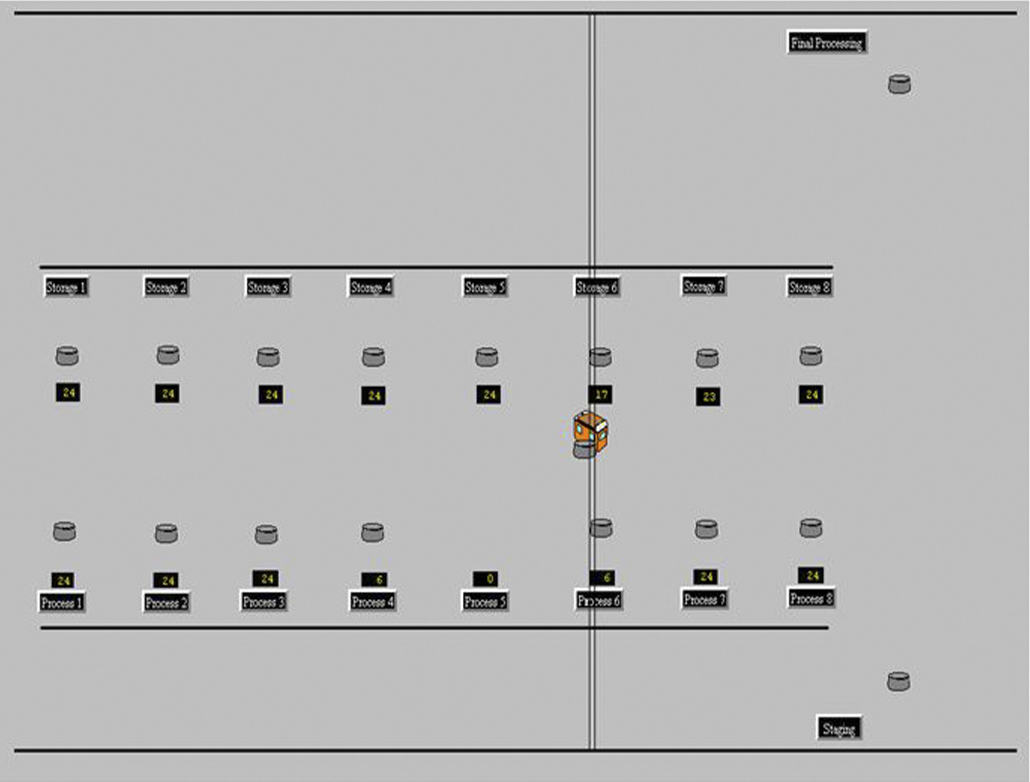
In mapping the process flow, it is important to note shared resources, such as material handling equipment, fork trucks, cranes, even personnel. Having established the process flow and a preliminary factory layout, the next key becomes to identify the capacity of all equipment throughout the process flow and what are the bottlenecks. Typically simple flow patterns will require a spreadsheet analysis of the hours required to complete the tasks and the hours available for each piece of equipment. Evaluation of more complex processes is aided by the utilization of simulation software.
Enclosed are a couple of project examples:
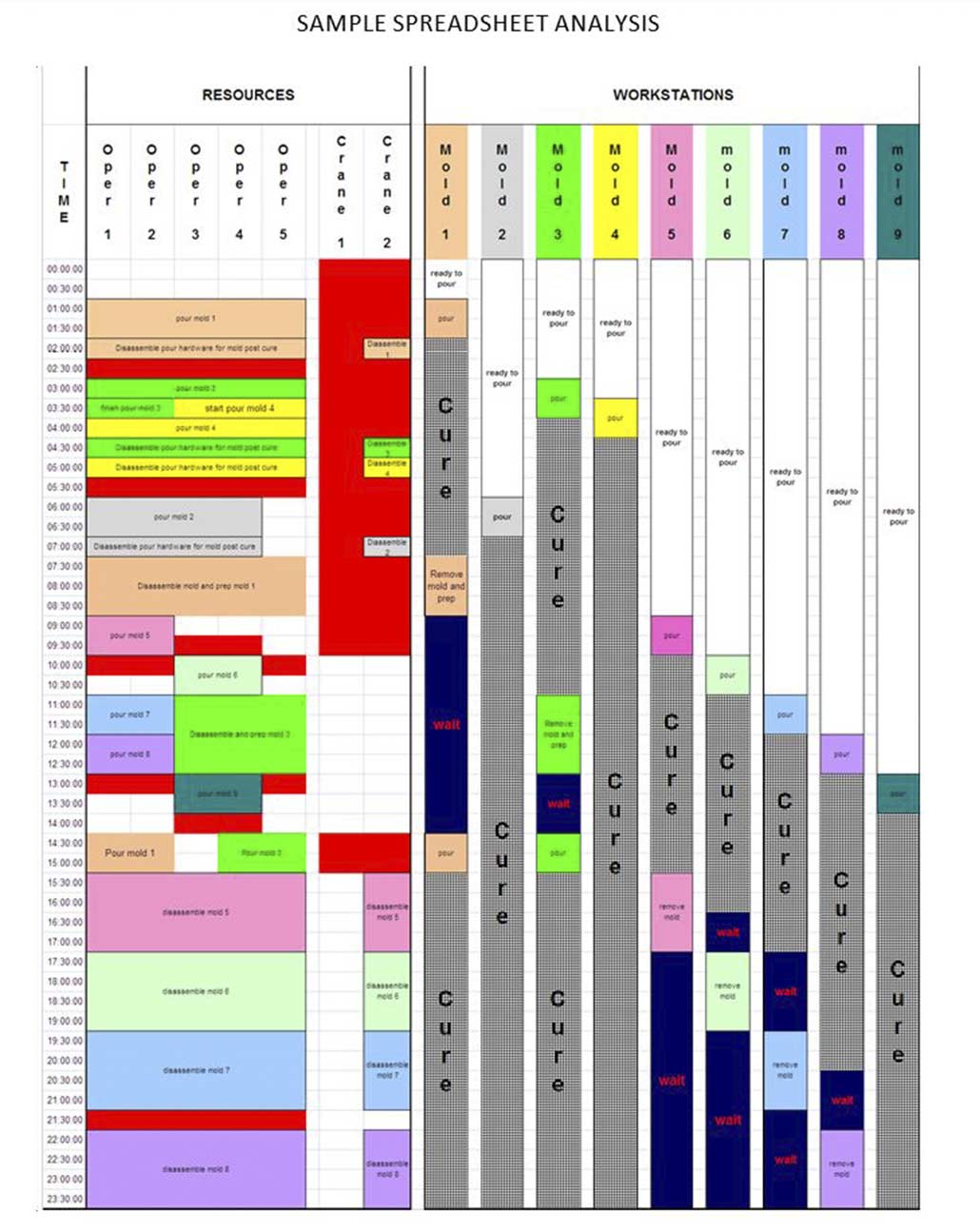
The following is a spreadsheet analysis of a metal producing facility. The resources identified are people and cranes. There are 9 workstations producing molded metal. The spreadsheet over a 24 hour work period identifies some of the bottlenecks. The bright red shaded areas in the resources identify when the resource is unavailable, and the shaded wait area shown in the molds identify an empty mold waiting for metal or other resources. Once the bottlenecks are identified, the project team can identify alternative strategies to increase capacity which may require additional equipment, additional resources, change in scheduling, etc.