Clinical –Drug Sponsor’s Clinical Studies/Trials
Phase 1
This phase emphasizes safety. The goal is to determine what the drug’s most frequent side effects are and how the drug is metabolized and excreted. (Typically 20 –80 healthy volunteers.)
Phase 2
This phase emphasizes effectiveness. The goal is to obtain preliminary data on whether the drug works in people who have a certain disease or condition. For Phase 2 trials, patients receiving the drug are compared with similar patients receiving a different treatment –usually a placebo or a different drug. Safety continues to be evaluated and short-term side effects are studied. (Typically a few dozen to about 300 people).
Review Meeting
At the end of Phase 2, the FDA and the drug sponsor discuss how large-scale studies in Phase 3will be done.
Phase 3
These studies gather more information about safety and effectiveness, study different populations and different dosages, and uses the drug in combination with other drugs. (Typically, several hundred to about 3,000people).
Review Meeting
FDA meets with the drug sponsor prior to submission of a New Drug Application.
NDA Application
The drug sponsor formally asks FDA to approve drug for marketing in the United States by submitting a New Drug Application (NDA). An NDA includes all animal and human data and analyses of the data as well as information about how the drug behaves in the body and how it is manufactured.
Application Reviewed
After the NDA is received, FDA has 60 days to decide whether to file it so it can be reviewed. If FDA files the NDA, the FDA Review Team is assigned to evaluate the sponsor’s research on the drug’s safety and effectiveness.
Drug Labeling
FDA reviews the drug’s labeling and assures appropriate information is communicated to healthcare professionals and consumers.Facility Inspection –FDA inspects the facilities where the drug will be manufactured.
Drug Approval
FDA reviewers will approve the application or issue a response letter.Hopefully, having some awareness of the FDAs stringent safety and quality program that must be followed to get anew vaccine to market provides some small amount of comfort in these very uncomfortable times.
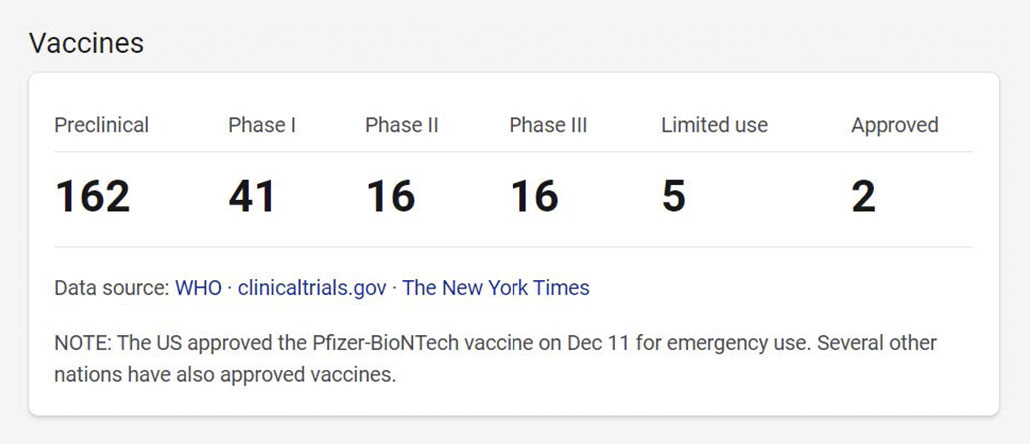
COVID-19 Vaccine Development Summary Taken from the FDA’s Drug Approval Process Infographic available on the FDA website.